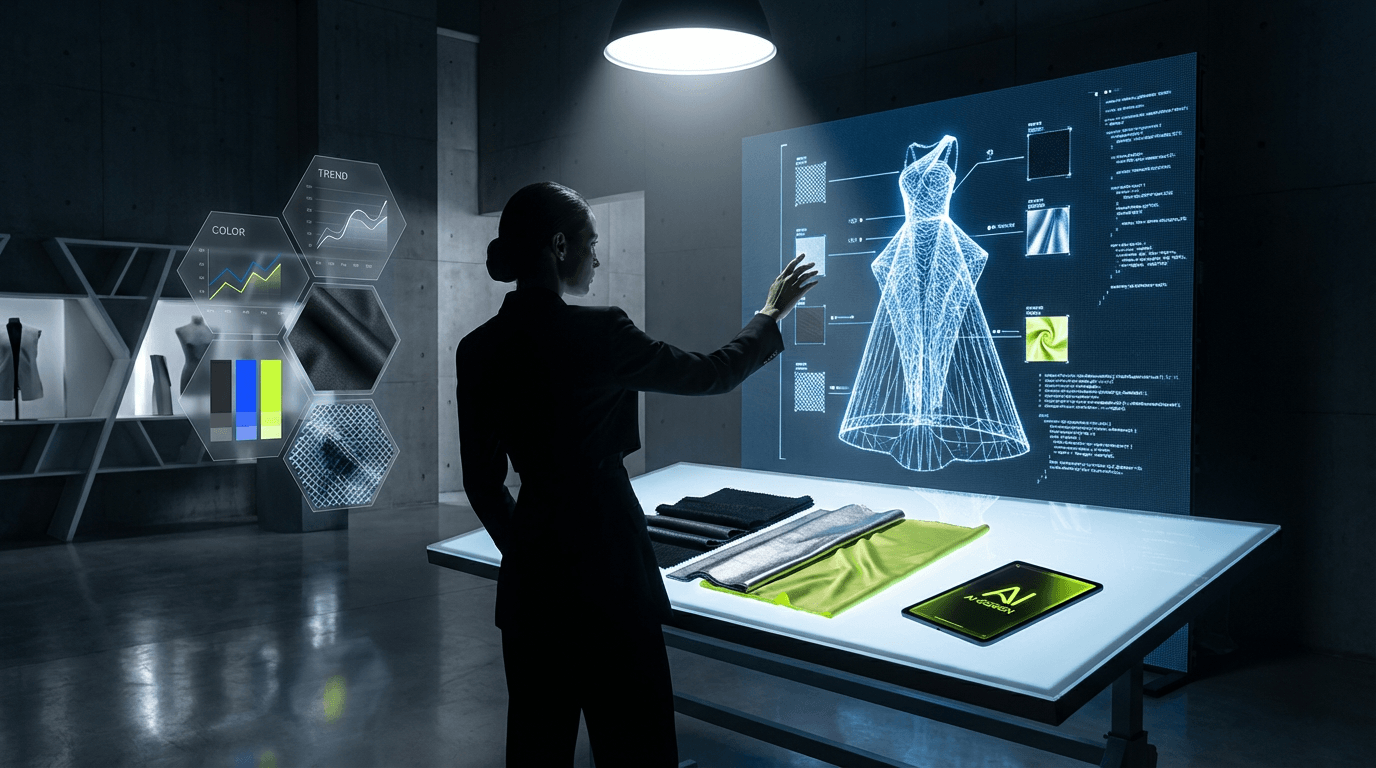
Fashion has always been about vision — the ability to see something that doesn't exist yet and bring it to life. For centuries, that vision lived exclusively in the minds of designers sketching by hand, draping fabric on mannequins, and obsessing over every seam. Today, a new creative partner has stepped into the atelier: artificial intelligence. AI in fashion design is no longer a distant concept or a tech-industry talking point. It is actively reshaping how collections are conceived, how trends are predicted, and how clothing reaches your closet.
From Balenciaga experimenting with algorithmic silhouettes to fast-fashion giants using machine learning to cut waste, AI is threading itself through every level of the industry. But the impact doesn't stop on the runway. The same technology powering high-fashion studios is now available to everyday shoppers — helping you discover your personal style, find affordable alternatives to luxury looks, and build a wardrobe that actually works for your life. This article breaks down exactly how designers are using AI to create their collections, and what that means for the way all of us experience fashion.
What Is AI in Fashion Design?
At its core, AI in fashion design refers to the use of machine learning algorithms, computer vision, generative models, and data analytics to assist or automate various stages of the design and production process. These tools can analyze millions of images, identify emerging patterns, generate new visual concepts, and even predict what consumers will want to buy months before a collection hits stores. Unlike traditional software that follows rigid rules, AI systems learn from data — meaning the more they're exposed to fashion content, the more refined and accurate their outputs become.
The technology spans a surprisingly wide range of applications. On one end, you have computational design tools that help architects-turned-fashion-designers like Iris van Herpen create structurally complex garments that would be nearly impossible to pattern by hand. On the other, you have retail-facing tools that scan a shopper's uploaded photo and recommend outfits tailored to their body shape, coloring, and personal taste. What unites all these applications is a shared goal: making the creative and commercial sides of fashion faster, smarter, and more responsive to real human needs.
How Designers Use AI to Build Collections
The design process traditionally begins with a mood board — a collage of images, textures, color swatches, and cultural references that sets the emotional direction of a collection. AI has transformed this step dramatically. Designers now feed visual references, historical archive imagery, and trend data into generative AI tools that can produce hundreds of preliminary sketches in minutes. Rather than replacing the designer's eye, these tools act as a creative accelerant, surfacing unexpected combinations and silhouettes that a human working alone might never encounter.
Tools like Adobe Firefly, Midjourney, and purpose-built fashion AI platforms such as Cala and Designovel allow designers to describe a concept in natural language and receive photorealistic garment renderings in return. A designer might type "structured blazer with deconstructed lapels in deep ochre, 1970s archive influence" and receive a dozen distinct interpretations within seconds. The designer then selects, refines, and directs — the AI handles the heavy lifting of visual iteration. This workflow compresses what used to be weeks of sketching into a concentrated creative sprint.
Beyond concept generation, AI also plays a critical role in the technical construction of garments. Pattern-making software powered by machine learning can automatically adjust sizing across a full size range, identify fabric waste in cutting layouts, and simulate how a garment will drape on different body types before a single piece of cloth is cut. Brands like Tommy Hilfiger and PVH Corp have invested heavily in these tools to reduce sample production — a notoriously wasteful and expensive part of the traditional design cycle.
AI-Powered Trend Forecasting: Seeing the Future of Style
Trend forecasting used to be the domain of a small group of industry insiders who traveled the world attending runway shows, street style events, and cultural gatherings to report back on what was gaining momentum. AI hasn't replaced that human intuition, but it has given it a dramatically wider lens. Modern trend forecasting platforms like Heuritech and WGSN now use AI to scan billions of social media posts, runway images, and e-commerce data points simultaneously, identifying micro-trends weeks or even months before they reach mainstream awareness.
For designers building a collection that won't hit stores for six to twelve months, this predictive intelligence is invaluable. An AI system might detect a rising interest in utilitarian outerwear among Gen Z consumers in Seoul and Tokyo, cross-reference that with early runway signals from emerging designers, and flag the trend with enough lead time for a brand to incorporate it meaningfully into their upcoming line. The result is collections that feel culturally plugged-in rather than reactive — a significant competitive advantage in an industry where timing is everything.
This same trend intelligence is increasingly available to consumers too. Real-time trend feeds and street style aggregators now bring runway-level awareness directly to your phone, surfacing what's breaking globally so you can stay ahead of the curve without spending hours scrolling through fashion week coverage on your own.
Generative AI and the Creative Process
Generative AI — the technology behind tools like DALL-E, Stable Diffusion, and Midjourney — has sparked one of the most heated debates in the fashion world: does AI-assisted design count as authentic creativity? The answer, increasingly, is yes — with important caveats. The most compelling AI-assisted fashion work happens when human designers treat generative models as collaborators rather than replacements. The designer still provides the creative brief, makes the aesthetic judgments, and brings cultural context that no algorithm can fully replicate.
What AI excels at is the exploration phase. It can surface unexpected material combinations, generate pattern variations at scale, and produce photorealistic visualizations of garments that don't yet physically exist. For independent designers and smaller studios without large teams, this capability is genuinely democratizing. A solo designer with a strong vision can now produce the kind of visual development work that previously required a full design team, making it possible to compete at a higher level without the overhead of a major fashion house.
Some luxury brands have also begun using AI to breathe new life into their archives. By training models on decades of historical designs, they can generate new pieces that feel authentically rooted in brand heritage while remaining contemporary. It's a sophisticated form of creative continuity that respects the past without being enslaved to it.
Sustainability: How AI Is Making Fashion Greener
The fashion industry is one of the world's largest polluters, responsible for roughly 10% of global carbon emissions and enormous textile waste. AI is becoming one of the most powerful tools in the push toward more sustainable practices. On the production side, AI-optimized cutting algorithms minimize fabric waste by calculating the most efficient layout for pattern pieces on a given bolt of cloth. Some systems have reduced fabric waste by up to 15% per garment, which adds up to an enormous impact at scale.
Demand forecasting is another area where AI is having a meaningful sustainability impact. Overproduction — making more garments than the market will absorb — is a chronic problem in fashion, particularly in fast fashion. AI-driven demand forecasting tools analyze purchase history, browsing behavior, seasonal patterns, and trend data to give brands much more accurate production targets. Less overproduction means fewer unsold garments ending up in landfills or incinerators, which has been a growing scandal for luxury and fast-fashion brands alike.
For consumers, AI-powered virtual try-on technology addresses one of e-commerce's biggest sustainability blind spots: the return. When shoppers can see realistically how a garment will look on their actual body before purchasing, they buy with more confidence and return far less. Virtual try-on tools have been shown to reduce return rates by 25 to 48%, cutting the carbon footprint associated with reverse logistics significantly.
AI in Fashion for Everyday Shoppers
The most exciting aspect of AI's rise in fashion is that its benefits are no longer confined to the industry's inner circle. The same machine learning capabilities that help Valentino refine a silhouette or Dior forecast a color palette are now available in consumer-facing apps that make getting dressed smarter, more personal, and a lot more fun. The gap between high-fashion thinking and everyday shopping is narrowing fast.
Trying On Celebrity Looks Before You Buy
One of the most tangible ways AI reaches everyday shoppers is through virtual try-on technology. Platforms like Alvin's Club let you upload your own photo and see exactly how a complete celebrity outfit looks on your body — not on a model with different proportions, but on you. Want to know if Zendaya's Met Gala silhouette actually flatters your frame, or how Dua Lipa's color palette works with your skin tone? Try on celebrity outfits virtually and find out before spending a single dollar.
Finding Affordable Dupes for Designer Looks
AI image recognition technology has also made it dramatically easier to shop smart. After trying on a high-end look from Celine or Valentino, you don't have to walk away empty-handed just because the price tag is out of reach. Smart dupe-finding tools automatically surface affordable alternatives that capture the same aesthetic at a fraction of the cost — making the "luxury look, everyday budget" equation genuinely solvable for the first time.
Solving Wardrobe Paralysis with Personalized OOTD
Perhaps the most relatable problem AI is solving for everyday shoppers is wardrobe paralysis: the experience of staring at a full closet and feeling like you have nothing to wear. AI-powered personalized outfit inspiration tools pull from your existing virtual wardrobe, factor in the season, upcoming holidays, and your personal style profile, and deliver daily outfit suggestions that actually make sense for your life. It's the equivalent of having a personal stylist on call — without the retainer fee.
Exploring Brand Looks From Your Favorite Stores
Fast-fashion brands like Zara release hundreds of new pieces every week, and keeping up can feel overwhelming. AI-powered Brand Look features curate the strongest looks from your favorite retailers and let you try them on virtually before heading to checkout — bringing the kind of edited, stylist-curated discovery experience that used to be reserved for magazine readers to anyone with a smartphone.
The Future of AI in Fashion Design
The trajectory of AI in fashion points toward an increasingly symbiotic relationship between human creativity and machine intelligence. In the near future, expect to see AI tools that can design garments fully customized to an individual's body measurements from the start, eliminating the alteration step entirely. Hyper-personalized collections — where a brand produces small runs of designs tailored to the demonstrated taste profiles of specific customer communities — are already in early development at several major houses.
On the design side, AI will continue to push the boundaries of what's physically possible. Computational design tools are enabling garments with structural complexity that traditional patternmaking simply can't achieve, opening up a new era of wearable architecture. At the same time, the ethical questions around AI creativity — authorship, labor displacement, data sourcing — will require serious ongoing attention from both the industry and the broader public.
What's clear is that AI is not replacing fashion's soul. The desire for self-expression, the cultural storytelling embedded in clothing, the emotional resonance of a perfectly chosen outfit — these remain irreducibly human. What AI is doing is removing friction: the friction of wasted fabric, unsold inventory, ill-fitting purchases, and the exhausting mental load of getting dressed every day. In doing so, it's making fashion more accessible, more sustainable, and more genuinely personal than it has ever been before.
The Bottom Line
AI in fashion design has moved well beyond the experimental stage. Designers are using it to accelerate creative development, forecast trends with unprecedented accuracy, reduce environmental waste, and build collections that resonate more deeply with the people who will actually wear them. The technology is sophisticated, the applications are growing, and the impact is real — both in the world's top studios and in the pockets of everyday shoppers.
The most exciting part? You don't have to be a fashion insider to benefit from any of this. The same AI intelligence reshaping how collections are made is also reshaping how you discover your style, try on new looks, and build a wardrobe you actually love. The future of fashion is personalized, intelligent, and more accessible than ever — and it's already here.
Experience AI Fashion for Yourself
Ready to bring the power of AI fashion design into your everyday wardrobe? Alvin's Club combines virtual try-on, celebrity outfit inspiration, smart dupe-finding, and real-time trend feeds into one beautifully simple platform. Try on the looks you love, discover what works for your body, and shop smarter — all in one place.
Download the App →