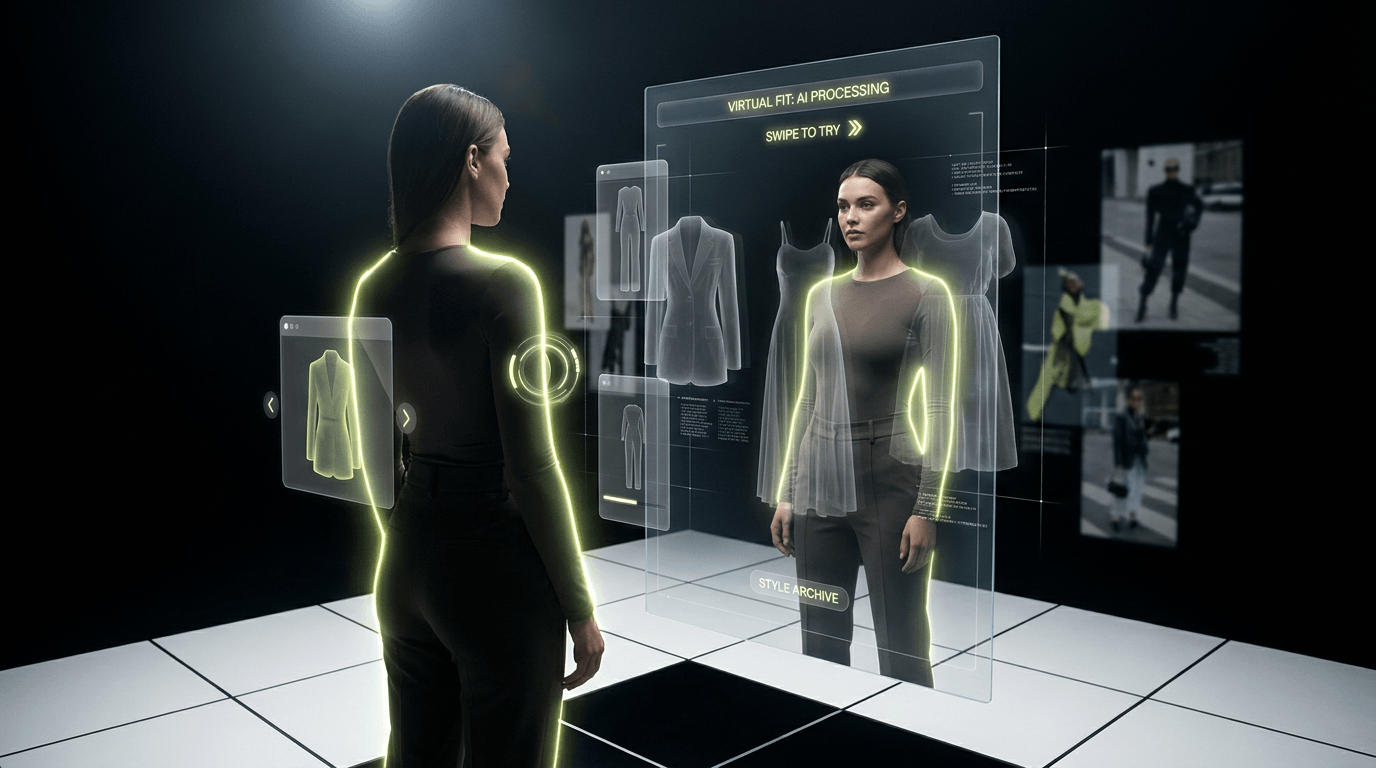
Picture this: you spot Zendaya in a breathtaking look at a red carpet event, wonder for half a second if you could pull it off, and — within moments — you're seeing exactly how that outfit sits on your body. No guessing. No buying and hoping. No disappointing return process weeks later. That's not a fantasy anymore. That's augmented reality shopping, and it's quietly rewriting every rule of how we discover, try, and buy clothing online.
Augmented reality (AR) in e-commerce has moved well past novelty status. What started as a fun filter on Snapchat has evolved into one of the most powerful tools in modern retail — reducing return rates, building purchase confidence, and making the kind of personalized styling that once required a private shopper genuinely accessible to everyone. And when you layer artificial intelligence on top of AR, the possibilities expand even further: smart style recommendations, celebrity outfit matching, affordable alternatives to luxury looks, and daily outfit inspiration built around your real wardrobe.
In this article, we'll break down exactly how augmented reality is reinventing e-commerce, explore the fashion-specific applications that are changing how real people shop, and show you how platforms like Alvin's Club are leading that charge.
Infographic — E-Commerce Insight
Augmented Reality Shopping:
Reinventing How We Buy Fashion
Virtual try-ons, AI styling, smarter decisions — AR is quietly rewriting every rule of online fashion.
The Numbers Behind the Revolution
48%
Reduction in Return Rates
with virtual try-on vs. standard photos
65%
More Likely to Purchase
when shoppers interact with AR product views
40%
Conversion Rate Lift
for retailers using AR virtual try-on tools
$1.2T
AR Market Projection
global AR market forecast value ahead
5 Key Takeaways
Virtual Try-On Works
AR maps real garments onto your body using AI — not just a filter, but a genuinely accurate fit preview that replaces the guesswork of online shopping.
Celebrity Style, Your Body
Upload your photo and instantly see how Zendaya’s red carpet look or Dua Lipa’s fit lands on your actual frame — making aspiration actionable.
Smart Dupes Surface Instantly
Image recognition analyzes designer silhouettes, color palettes and details — then surfaces affordable alternatives automatically. Luxury aesthetic, real-world budget.
AI Solves Wardrobe Paralysis
A virtual closet paired with AI delivers daily OOTD suggestions tuned to weather, season and what you already own — like a stylist built into your phone.
Real-Time Trend Intelligence
Global street style, runway moments and social content aggregated into one feed — spot a trend, try it on, find it or its dupe, all in one session.
The AR Shopping Journey
Step 01
📸
Upload Your Photo
Your body. Your reference point. No model required.
Step 02
👁️
Try It On Virtually
AR maps the look onto your proportions in real time.
Step 03
🔍
Find Your Version
Buy the exact piece or discover a smart, affordable dupe.
Step 04
✅
Buy with Confidence
Informed decision. Far fewer returns. Zero regret.
Quick FAQ
Does virtual try-on actually reduce returns?
Yes — studies and retailer data consistently show a 25–48% drop in return rates when shoppers preview garments on their own body before purchasing.
Is AR shopping only for luxury brands?
Not at all. Platforms like Alvin’s Club are built specifically to make high-fashion thinking — including smart dupe-finding — accessible across every budget.
Do I need special hardware?
No. Most modern smartphones — including mid-range Android devices and recent iPhones — fully support AR shopping apps without any extra equipment.
How does AI improve the AR experience?
AI adds context beyond the visual — personalized outfit recommendations, wardrobe intelligence, style matching, and automatic detection of affordable alternatives to expensive pieces.
Try It Yourself
Stop Guessing. See It On Your Body.
Alvin’s Club combines AR try-on, celebrity style matching, smart dupes, and AI outfit inspiration — all in one place, on any smartphone.
ALVIN’S CLUB — AI-POWERED FASHION SHOPPING — alvinclub.ai
What Is Augmented Reality Shopping?
Augmented reality shopping is the use of digital overlay technology to let consumers interact with products in a virtual space before purchasing them. Unlike virtual reality, which places you inside a fully digital world, AR layers digital information on top of your real environment — usually through your smartphone camera. In a retail context, this means you can hold up your phone and see a pair of sneakers on your feet, a couch in your living room, or a full outfit on your body, all without touching a single physical product.
For fashion specifically, AR has become an essential bridge between the tactile experience of in-store shopping and the convenience of buying online. When you shop in a store, you try things on. You feel the fabric, check the fit in a mirror, and make an informed decision. Online shopping has historically stripped all of that away. AR gives it back — and in many ways, it goes further than a standard fitting room ever could, letting you compare multiple outfits instantly, shop styles from around the world, and get AI-powered feedback on what actually works for your body and taste.
Why AR Is a Game-Changer for Online Shoppers
The core problem with online fashion shopping has always been uncertainty. You see a beautiful blouse on a model with a completely different body type, in studio lighting, styled by a professional. You buy it. It arrives and looks nothing like you imagined. You package it back up, file a return, and feel vaguely let down by the entire process. This cycle costs shoppers time, money, and emotional energy — and it costs retailers billions in reverse logistics every year.
AR directly attacks that uncertainty. When shoppers can see how a garment drapes, how a color interacts with their skin tone, and how a silhouette fits their proportions before clicking "buy," the entire transaction becomes more confident and intentional. Research consistently shows that virtual try-on technology reduces return rates by anywhere from 25% to 48%, which is a staggering improvement considering that fashion return rates online routinely hit 30% or higher. Beyond the financial math, there's something genuinely empowering about shopping with that level of information. It transforms the experience from a gamble into a decision.
Purchase confidence also rises measurably. Studies have found that shoppers who interact with products through AR are significantly more likely to complete a purchase — in some cases up to 65% more likely — compared to those browsing standard product images. AR doesn't just reduce bad purchases; it actively encourages good ones.
Virtual Try-On: The Heart of AR Fashion
Virtual try-on is the technology most people associate with AR in fashion, and for good reason — it's the most direct translation of the in-store fitting room experience into a digital format. At its most basic level, virtual try-on uses your device's camera, combined with computer vision and machine learning, to map clothing, accessories, or makeup onto your body or face in real time. More advanced implementations allow you to upload a photo of yourself and receive a highly accurate visualization of how a specific garment will look on your actual proportions.
The sophistication of this technology has grown enormously in recent years. Early virtual try-on tools were stiff and unconvincing — the digital clothing barely moved with the body and often looked pasted on rather than worn. Today's AI-powered systems account for body shape, posture, lighting conditions, and even fabric physics, producing results that feel genuinely informative rather than cosmetic. For shoppers, this means the try-on experience is no longer just fun — it's actually useful for making real purchasing decisions.
Platforms built around virtual try-on are also solving one of fashion's oldest access problems: the gap between aspirational style and real-world wearability. Seeing a look styled on a size-2 model in a magazine tells you almost nothing about how it will look on a size-14 body. AR try-on gives every shopper the ability to evaluate fashion on their own terms, using their own reflection as the reference point.
From Celebrity Runways to Your Closet
One of the most exciting applications of AR in fashion right now is the ability to try on celebrity and style icon outfits directly on your own body. For years, the only way to engage with celebrity fashion was passive admiration — scrolling through a red carpet gallery and wondering, abstractly, whether you could wear something similar. Now, that interaction has become active and personal.
With Alvin's Club, users can upload their own photo and virtually try on complete celebrity outfits from style icons like Zendaya, Dua Lipa, and Timothée Chalamet — seeing in real time how specific colors, cuts, and silhouettes work on their own body before making any purchasing decisions. This isn't about becoming someone else. It's about using cultural style moments as a starting point for understanding your own taste and what genuinely translates to your frame and lifestyle. When you can see an outfit on yourself rather than on a celebrity, the decision-making becomes infinitely clearer.
This feature also collapses the distance between high fashion inspiration and everyday shopping behavior. Instead of admiring a look from a distance and moving on, shoppers can immediately explore where to buy similar pieces, see how the full outfit works together, and decide whether it actually belongs in their wardrobe — all within a single session.
AR Meets Affordability: Finding Your Perfect Dupe
One of the most persistent frustrations in fashion is the gap between the looks you love and the budget you actually have. A Celine blazer or a Valentino bag might be aspirational icons, but for most shoppers, they live firmly in the "someday" category. AR-powered fashion platforms are solving this problem in a genuinely clever way: by combining virtual try-on with intelligent image recognition to surface affordable alternatives automatically.
The process works like this. You try on a designer or celebrity look using the AR tool. You love how it looks on you. The platform's image recognition technology analyzes the key visual elements — silhouette, color palette, fabric texture, design details — and automatically surfaces smart dupes and affordable alternatives from accessible brands that capture the same aesthetic at a fraction of the price. It's the "luxury aesthetic, everyday budget" solution that millions of fashion-forward shoppers have been waiting for.
This matters because style democracy is one of the defining conversations in fashion right now. The idea that great personal style should be available regardless of income level is increasingly mainstream — and technology is finally catching up with that value. AR doesn't just make shopping more visual; it makes it more equitable.
Wardrobe Intelligence and Personalized OOTD
There's a specific kind of frustration that strikes when you're standing in front of a packed closet with absolutely no idea what to wear. Wardrobe paralysis is real, and it affects people across every style level and budget bracket. Having more clothes doesn't necessarily mean having more outfit clarity — in fact, it often makes the problem worse. This is one of the most human problems in fashion, and it's exactly where AI-powered platforms are starting to make a meaningful difference.
By building a virtual closet within an app, shoppers can receive personalized daily outfit inspiration (OOTD) tailored to the current season, upcoming holidays, local weather, and the specific pieces they already own. Instead of staring at your wardrobe and feeling overwhelmed, you get intelligent suggestions that make use of what you have, filling gaps only when there's a genuine style reason to do so. It's a bit like having a personal stylist built into your phone — one that knows your wardrobe better than you do and never runs out of ideas.
This feature also reduces impulse buying by helping shoppers understand and utilize their existing wardrobe more fully. When you can see clearly what you have, what works together, and what's genuinely missing, shopping decisions become more intentional and satisfying.
Real-Time Trends: Street Style Goes Digital
Fashion trends used to travel slowly — from runway to magazine to retailer to shopper, the cycle took months. Social media compressed that timeline dramatically, but even scrolling Instagram or TikTok requires significant effort to synthesize what's actually emerging versus what's just momentarily viral. The next evolution is real-time trend intelligence: aggregated, personalized, and immediately actionable.
A real-time trend feed that pulls from global street style, runway moments, and social content gives shoppers a genuinely current picture of where fashion is moving — not a curated editorial fantasy, but the actual clothes real people are wearing in cities around the world. This kind of feed, when paired with AR try-on capability, creates a seamless loop: you spot a trend, you see how it looks on your body, and you either find the exact piece or an affordable version of it. The entire journey from inspiration to purchase decision can happen in minutes.
Staying ahead of trends used to require either a subscription to Vogue or an obsessive social media presence. Platforms that aggregate and surface this intelligence automatically lower the barrier significantly, making trend awareness a feature everyone can access rather than a privilege reserved for the deeply plugged-in.
The Numbers Behind the AR Revolution
The business case for AR in fashion and e-commerce is backed by compelling data. The global augmented reality market was valued at over $40 billion in 2022 and is projected to reach nearly $1.2 trillion by 2032, reflecting a compound annual growth rate that few technology sectors can match. Consumer enthusiasm is driving much of that growth — surveys consistently show that a large majority of shoppers would use AR features if they were available, and younger demographics in particular expect immersive digital shopping experiences as a baseline rather than a luxury.
On the business side, the metrics speak clearly. Retailers implementing AR virtual try-on see conversion rate increases ranging from 27% to 40%, alongside those dramatic return rate reductions of 25% to 48%. These aren't marginal improvements — they represent fundamental shifts in how efficiently fashion retail can operate when shoppers make better-informed decisions. For consumers, this translates directly into less wasted money, fewer frustrating returns, and a shopping experience that actually delivers what it promises.
What the Future of AR Shopping Looks Like
The AR shopping experience available today is impressive, but it's genuinely early in the development curve. Several trends point toward an even richer future. Hardware improvements in smartphones — particularly better depth-sensing technology and more powerful on-device AI chips — are making AR visualizations more accurate and more responsive with each new device generation. As these capabilities become standard across mid-range phones, not just flagship models, AR try-on will reach a much wider audience.
The convergence of AR with artificial intelligence is perhaps the most significant frontier. Current AR tools show you how something looks. Future AI-AR hybrids will tell you whether it's a good fit for your style profile, flag whether you already own something similar, predict whether you'll actually wear it based on your history, and suggest how to style it with pieces you already have. The shopping agent model — an AI that actively helps you make better decisions rather than passively displaying products — is emerging as the natural evolution of what AR started.
Social and community dimensions will also deepen. The ability to share AR try-on moments, get feedback from friends before purchasing, and see how real people (not just models) are wearing trends in real time will make fashion discovery more collaborative and less solitary. Platforms that combine the intelligence of AI with the authenticity of community are positioned to define what shopping looks and feels like for the next generation of consumers.
Frequently Asked Questions
What is augmented reality shopping?
Augmented reality shopping uses your smartphone camera or device to overlay digital product images onto your real environment or body. In fashion, this most commonly means virtual try-on — seeing how clothes, shoes, or accessories look on you without physically trying them on. The technology combines computer vision, machine learning, and real-time rendering to create accurate, interactive product visualizations.
Does virtual try-on actually reduce returns?
Yes, and the evidence is strong. Studies and retailer case studies consistently show that virtual try-on reduces return rates by 25% to 48% compared to standard product photography. The logic is straightforward: when shoppers have a realistic preview of how something will look on their actual body, they make better-informed purchases and are less likely to be disappointed when the item arrives.
Is AR shopping only for high-end brands?
Not at all. While luxury brands were early adopters of AR try-on technology, the tools are now widely accessible across price points. Platforms like Alvin's Club are specifically built around making high-fashion thinking accessible to everyone — including features that surface affordable dupes for designer looks, making AR style technology genuinely democratic.
How does AI enhance augmented reality in fashion?
AI takes AR from a visual novelty to a genuinely intelligent shopping assistant. Where AR provides the visualization (showing you how something looks), AI adds context, personalization, and decision-support. This includes features like personalized outfit recommendations, intelligent wardrobe management, style matching based on your preferences, and automatic detection of affordable alternatives to expensive pieces.
Can I use AR shopping on my current smartphone?
Most modern smartphones — including mid-range Android devices and iPhones from the past several years — support AR shopping applications. Apps like Alvin's Club are designed to work within standard smartphone cameras, making the technology accessible without requiring any specialized hardware or expensive equipment.
The Fitting Room Has Gone Digital — and It's Better Than Ever
Augmented reality shopping isn't a future concept or a feature reserved for tech enthusiasts. It's here, it works, and for fashion specifically, it's solving problems that have plagued online shopping since the beginning — uncertainty, sizing anxiety, the gap between inspiration and reality, and the exhausting cycle of buying and returning. The combination of AR visualization with AI-powered personalization represents the most significant shift in how we shop for clothing since e-commerce itself.
For shoppers, the practical benefits are immediate: more confidence in purchasing decisions, fewer returns, and a genuinely enjoyable experience that makes exploring style feel exciting rather than overwhelming. For fashion culture more broadly, AR is enabling a kind of style access and self-expression that simply wasn't possible before — putting celebrity fashion, trend intelligence, and personal styling assistance within reach of anyone with a smartphone.
The technology will continue to improve. The experiences will get richer, the visualizations more accurate, the AI recommendations more precisely tuned to individual taste. But the core transformation is already underway, and the brands and platforms building for that future are changing what it means to truly know how something will look before you buy it.
Try On the Future of Fashion — On Your Own Body
Alvin's Club brings augmented reality shopping to life with AI-powered celebrity try-ons, personalized outfit inspiration, smart style dupes, and real-time trend feeds — all in one place. Stop guessing how something will look. See it for yourself.
Explore Alvin's ClubDownload the App