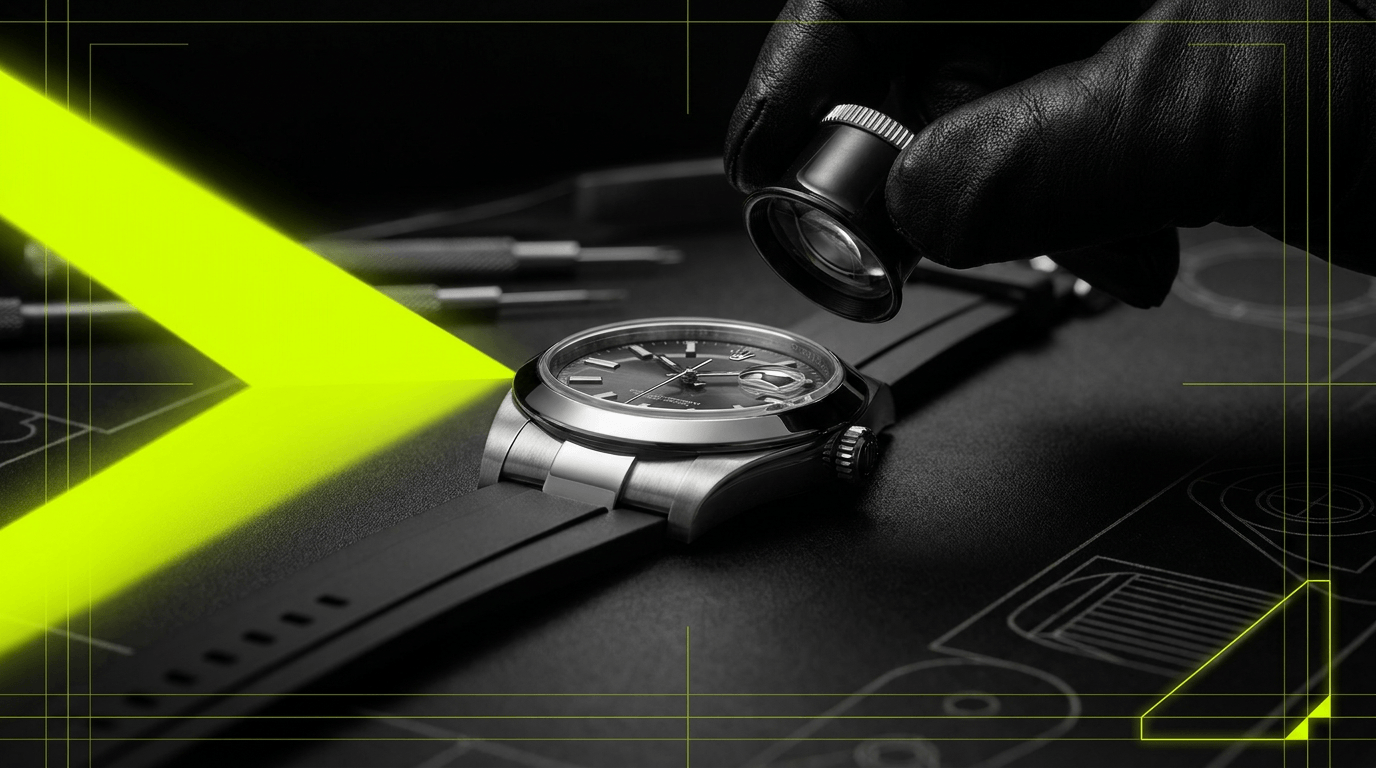
You spot a Rolex at a flea market, a holiday market stall, or someone's online listing — and the price seems almost too good. The crown logo is there. The bracelet looks solid. The dial looks clean. But something feels slightly off, and you can't quite put your finger on it.
Here's the truth: today's counterfeit Rolex watches are more convincing than ever. What used to be an obvious knockoff with a wobbly second hand and cheap plastic crystal has evolved into high-grade "super fakes" that can fool even experienced watch enthusiasts at a glance. The global counterfeit watch market is worth billions, and Rolex is consistently the most faked luxury watch brand in the world.
The good news? If you know exactly what to look for, you can spot a fake Rolex in under 60 seconds. This guide breaks down every tell-tale sign, from the way the second hand moves to the micro-etching on the crystal you've probably never heard of, so you never pay real money for a fake. And if the whole reason you love Rolex is the aesthetic rather than the investment, we'll show you a smarter way to get that luxury look without the counterfeit risk.
Why Fake Rolexes Are Fooling Almost Everyone
The counterfeit watch industry has undergone a remarkable and troubling transformation over the past decade. Early fakes were easy to dismiss: flimsy cases, obvious typos on the dial, a second hand that ticked instead of swept. Modern counterfeits, often called "super fakes" or "super clones," are produced using optical scanning technology and 3D printing, allowing manufacturers to replicate a Rolex down to the weight distribution and bracelet finishing. Some super fakes even feature cloned automatic movements that pass a casual inspection.
What makes this particularly dangerous for buyers is that these watches are increasingly sold through mainstream channels — eBay listings, Facebook Marketplace, Instagram ads, and even seemingly legitimate secondhand watch sites. A platform that functions as a middleman between buyers and sellers carries no legal responsibility for the authenticity of what's sold through it, which means the entire burden of verification falls on you. Knowing how to authenticate a Rolex yourself is no longer optional — it's essential.
The 60-Second Fake Rolex Checklist
Before diving into each test in detail, here's your rapid-reference checklist. Run through these in order when evaluating any Rolex in person:
- Does the second hand sweep smoothly, or does it tick?
- Does the watch feel substantial and heavy in your hand?
- Does the date magnify clearly through the cyclops lens?
- Is the dial printing flawless, with no smudging or uneven spacing?
- Are the serial and model numbers sharply laser-engraved?
- Is the caseback solid metal with no transparent window?
- Can you see a tiny crown etching on the crystal near 6 o'clock (post-2002 models)?
- Is the Rolex name and crown logo present on the dial, crown, and clasp?
If any of these checks raise a red flag, stop and investigate further. Now let's go deeper on each one.
1. The Sweep of the Second Hand
This is the fastest single test you can perform, and it works almost every time on lower-quality fakes. Pick up the watch and watch the second hand move. A genuine Rolex is powered by an automatic mechanical movement that advances the second hand roughly 8 times per second, creating a smooth, almost gliding sweep around the dial. There is no visible tick or stutter — the motion is fluid and continuous.
Counterfeit watches almost universally use inexpensive quartz movements, which cause the second hand to move in a distinct one-second tick. Some higher-end super fakes use mechanical movements with a slower beat that creates a micro-tick, but even these feel choppier than the genuine article when observed closely. Throughout its entire history, Rolex has produced only a handful of quartz-movement watches, making them extremely rare exceptions. If the second hand ticks, put it down.
2. Weight and Feel in Your Hand
A real Rolex has a satisfying, unmistakable heft. This comes from the brand's use of 904L stainless steel, an aerospace-grade alloy that is denser and harder than the 316L steel used by most other watchmakers (and virtually all counterfeiters). Rolex also uses 18k gold in several of its alloys, including its proprietary Everose rose gold blend and 950 platinum for platinum models. Every link of the bracelet, every component of the case — all of it is produced from premium materials that add up to a distinctly weighty feel.
A fake Rolex made from cheaper pot metal or low-grade steel will feel noticeably lighter, almost hollow by comparison. When you hold a genuine Rolex, it communicates quality through pure physical presence. This test isn't foolproof for super fakes, which have improved significantly in weight approximation, but it remains a reliable first filter for the majority of counterfeits you'll encounter in the real world.
3. The Cyclops Lens Test
Look at the date window on the watch face. On any genuine Rolex date model, a small convex magnifying lens called the Cyclops sits directly over the date display on the crystal. This lens is made from sapphire crystal and is designed to magnify the date numeral exactly 2.5 times, making it large and easy to read at a glance. The magnification should be dramatic and obvious — the number should appear to leap forward toward you.
On a fake Rolex, the cyclops lens is commonly either flat (providing little to no magnification) or only magnifies by 1.5 times rather than the correct 2.5. This is one of the most consistently failed details in counterfeit production, because replicating the exact curvature and optical properties of Rolex's sapphire cyclops is extremely difficult. If the date looks small or only slightly larger through the lens, it's a serious red flag. Note that some vintage models and the Sea-Dweller Deepsea do not have a cyclops — so always verify for the specific reference you're examining.
4. Dial Quality and Brand Markings
The dial of a genuine Rolex is a miniature masterpiece of precision. The "ROLEX" text, the crown logo (called the coronet), and all subsidiary text such as "Oyster Perpetual," "Datejust," or "Submariner" are printed with absolute perfection — consistent letter spacing, zero smudging, and perfectly even ink density. The finishing on the hands and hour markers is immaculate, with no rough edges, uneven luming, or misalignment. Every element on the dial has a reason to be exactly where it is.
Counterfeiters frequently get tripped up by font inconsistencies, slightly off-center crowns, or lume that looks bubbly or uneven under close inspection. Some lower-quality fakes even omit the Rolex name or crown altogether. Compare the dial you're examining against official Rolex reference images for that specific model — any deviation in text layout, hand shape, or marker design is a strong indicator of a fake. The rehaut (the inner bezel ring between the dial and crystal) on genuine modern Rolexes is also engraved with "ROLEX ROLEX ROLEX" continuously around the ring, along with the serial number at 6 o'clock. This is another detail fakes routinely miss or execute poorly.
5. Serial and Model Number Engravings
On a genuine Rolex, the serial number is engraved between the lugs at 6 o'clock on the case, and the model (reference) number appears between the lugs at 12 o'clock. These engravings are made with laser precision — the edges are sharp and clean, with a diamond-cut quality that catches light beautifully. Under a loupe or even a good smartphone camera, the numbers should look crisp and individually defined, almost like tiny mirrors.
Counterfeit engravings are typically sand-blasted or acid-etched, giving them a rough, granular appearance rather than sharp precision cuts. They may also look dotted or slightly blurred under magnification. One particularly useful trick: counterfeiters sometimes reuse the same serial number across multiple fake watches, since they don't maintain authentic production records. If the serial number you find duplicates a known reference, or if it doesn't match the production date range for the model in question, that's a definitive red flag worth investigating further.
6. The Caseback — Solid or Suspicious?
Turn the watch over and look at the back of the case. With very few historical exceptions (certain 1930s vintage pieces and the limited 60th-anniversary platinum Daytona), Rolex has never produced a watch with a transparent or "exhibition" caseback. The entire ethos of Rolex design favors a solid, smooth, closed caseback — you simply cannot see the movement through the back of a genuine Rolex.
Counterfeit makers frequently add a clear caseback specifically to show off a movement and create an impression of mechanical sophistication and value. This is almost always a fabricated spectacle. If you flip a watch over and can see gears turning through a glass window, it is almost certainly not a genuine Rolex. Similarly, if the caseback features decorative engravings, logos, or illustrations that weren't requested as a personal inscription, that's another counterfeit signal. Genuine Rolex casebacks are clean, minimalist, and solid — a quiet confidence that doesn't need to show off.
7. The Micro-Etched Crystal Crown
This is one of the most powerful authentication tools available, and it's one most people have never heard of. Beginning in 2002, Rolex began laser-etching a tiny Rolex crown logo into the sapphire crystal of every watch, positioned at the 6 o'clock position. It is extraordinarily small — invisible to the naked eye under normal lighting, requiring a loupe or strong magnifying glass and a specific angle of light to see clearly.
Because it is so difficult to see and even harder to replicate with the required precision, this micro-etching serves as a highly reliable authentication marker for any Rolex produced from 2002 onward. Counterfeiters either omit it entirely or produce a version that is visibly imperfect and inconsistently placed when examined under magnification. If you're evaluating a post-2002 Rolex and cannot find the crown etching after a careful inspection with a loupe, treat that as a serious concern.
8. What's Inside: The Movement
Every genuine Rolex runs on a mechanical movement that Rolex manufactures in-house at its facilities in Switzerland. These calibers are certified chronometers, meaning they've been tested to extremely tight accuracy standards by COSC (the Swiss Official Chronometer Testing Institute) and Rolex's own internal benchmarks. The finishing inside a genuine Rolex movement — the beveling, the engravings, the rotor — is meticulous even though most wearers will never see it.
As mentioned, a ticking second hand is your quickest movement red flag. But for super fakes that use cloned mechanical movements, the tell is in the finishing quality and accuracy over time. If you can have a watchmaker open and inspect the movement, genuine Rolex calibers will display a level of machining quality that no counterfeit has successfully replicated at scale. The rotor bearing on a genuine Rolex also has a near-silent, smooth spin — fakes often produce a rattling or grinding sound when the rotor is tested.
9. Always Buy From a Trusted Source
Every test in this guide helps, but none of them replace the security of purchasing from a reputable, verified source. Authorized Rolex retailers and established pre-owned watch specialists who provide authentication guarantees are your safest option. Be especially cautious with marketplace platforms like eBay, Facebook Marketplace, or Craigslist, where sellers have no accountability for authenticity and where counterfeit listings can look professionally presented.
When a deal looks too good to be true on a Rolex, it almost certainly is. A Submariner retails for well over $9,000 new, and reputable pre-owned examples rarely drop dramatically below market value. If someone is offering a Rolex at a fraction of market price without a clear, verifiable explanation (such as documented financial distress or an estate sale with paperwork), the most likely explanation is that it isn't real. Trust your instincts, do your research, and never let time pressure from a seller rush you into an unverified purchase.
Love the Luxury Look Without the Luxury Price?
Here's something the watch authentication world rarely talks about: for most people, the appeal of a Rolex isn't the resale value or the movement architecture — it's the aesthetic. The brushed and polished steel bracelet, the clean-dialed elegance, the understated prestige of wearing something that looks expensive and intentional. And that aesthetic? You don't have to risk thousands of dollars on a counterfeit to achieve it.
Alvin's Club is built on exactly this philosophy. The platform uses image recognition technology to surface affordable dupes and smart alternatives to high-end fashion items — not fakes, but genuinely stylish pieces that deliver the look without the counterfeit risk or the luxury markup. Whether you're eyeing the clean minimalism of a Rolex-inspired accessory or trying to build a complete elevated outfit around a watch, the app helps you find pieces that actually work on your body through its virtual try-on technology.
The difference between a counterfeit and a smart dupe is honesty. A fake Rolex pretends to be something it isn't. A smart alternative is transparent about what it is — an accessible, stylish choice that gets you the aesthetic without the deception. Alvin's Club helps you make those smarter choices every day, whether you're building a full outfit around a luxury watch or finding the best ensemble to complement an elevated accessory. Fashion should be about how you feel in what you wear — not about whether you can decode laser-etched serial numbers under a loupe.
Final Verdict: What to Do When You're Not Sure
Spotting a fake Rolex is a skill, not an instinct — and even experienced collectors occasionally encounter counterfeits convincing enough to give them pause. If you run through this checklist and even one or two elements don't feel right, the safest move is always to walk away or have the watch inspected by a certified watchmaker before handing over any money.
To recap the fastest checks you can do in under 60 seconds: watch the second hand for a smooth sweep (not a tick), feel the weight of the case and bracelet, check the cyclops lens magnification, scan the dial for perfect printing and the Rolex crown logo, and flip it over to confirm a solid, engraving-free caseback. For post-2002 models, look for the micro-etched crown on the crystal. Any failure on these basic tests should stop your purchase immediately.
And if what you truly love is the elevated, polished aesthetic that a luxury watch projects? There are smarter, more honest ways to build that look. Explore the possibilities at Alvin's Club and discover how great style never has to come at the cost of authenticity.
Style Smarter. Shop Honestly.
Why risk thousands on a counterfeit when you can get the luxury aesthetic through smarter choices? Alvin's Club helps you discover affordable alternatives, try on complete looks virtually, and shop with confidence — no loupe required.
Explore Alvin's Club Download the App