You've been there. You order a dress in your usual size, wait a week for it to arrive, try it on, and it fits nothing like it did on the model. Back it goes. The whole frustrating cycle repeats. In fact, sizing inconsistency is the single biggest driver of fashion returns globally, costing retailers and shoppers billions of dollars and enormous amounts of wasted time each year.
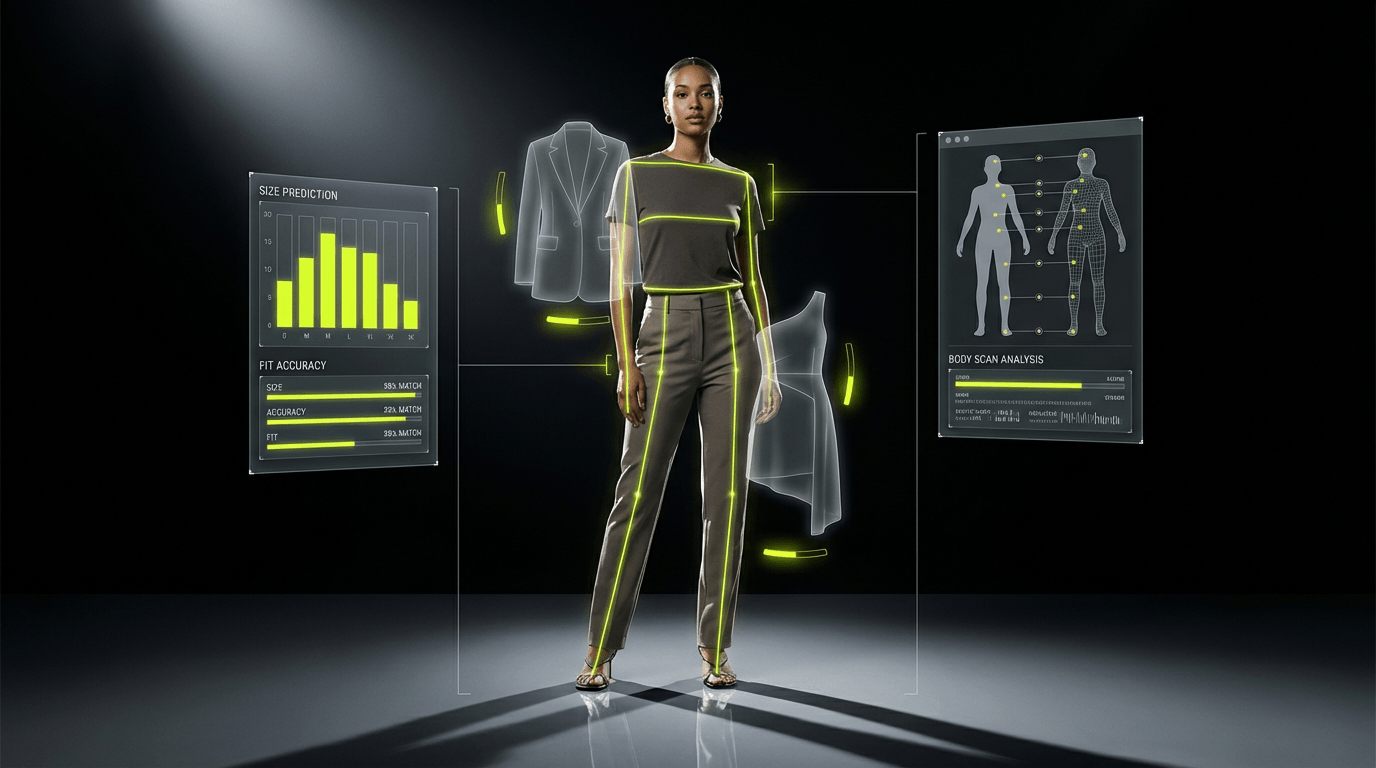
Enter AI fit predictors — a rapidly maturing category of technology that's fundamentally changing how we shop for clothes online. These systems don't just suggest a generic size chart. They analyze your actual body measurements, compare them against thousands of garment data points, and tell you — with impressive specificity — whether that blazer will sit right on your shoulders or that pair of jeans will gap at the waist. And when they're paired with AI-powered virtual try-on platforms like Alvin's Club, the result is a shopping experience that's smarter, more confident, and far more personal than anything a standard size guide could offer.
In this article, we break down exactly how AI fit predictors work, why they've become essential in modern fashion tech, and how combining fit intelligence with visual try-on tools is reshaping the way we discover and buy clothing.
What Is an AI Fit Predictor?
An AI fit predictor is a software system that uses machine learning, body measurement data, and garment construction information to recommend the most appropriate size for a specific person buying a specific item. Unlike a traditional size chart — which offers a blunt one-size-fits-most translation of measurements — an AI fit predictor accounts for individual body shape, fabric stretch, brand-specific cut, and even the intended fit style of a garment (relaxed vs. tailored, for example).
These tools are now embedded across major e-commerce platforms, virtual fitting room apps, and AI fashion assistants. Some work through simple questionnaires. Others use computer vision to analyze body dimensions directly from a photo. The most advanced systems combine both approaches, layering in purchase history and return data to continuously improve their recommendations over time.
How AI Estimates Your Size: The Technology Behind It
At its core, an AI fit predictor is a pattern-recognition engine trained on enormous datasets. To understand how it works, it helps to look at the three layers of data it typically processes:
1. Body Measurement Data
This is the foundation. The system needs to understand your body — specifically, dimensions like bust, waist, hips, inseam, shoulder width, and torso length. This data can be gathered in several ways: manual self-measurement input, answers to a structured questionnaire (height, weight, age, body shape preference), or computer vision analysis of a photo you upload. The photo-based approach has advanced dramatically in recent years, with depth-sensing algorithms now capable of estimating body proportions from a single 2D image with high precision.
2. Garment Construction Data
Every piece of clothing has a spec sheet — a detailed breakdown of how it's constructed, including measurements at key points (chest at size M, hip at size L, etc.), fabric composition and stretch factor, and the intended silhouette. AI fit systems ingest this garment-level data and map it against your body measurements to find the closest match. This is why two "medium" shirts from different brands can fit completely differently: the AI accounts for those brand-specific variations rather than assuming all mediums are equal.
3. Behavioral and Return Data
The most sophisticated fit engines also incorporate anonymized purchase and return data from thousands of previous shoppers. If a significant number of buyers with similar measurements returned a specific jacket for being too narrow in the shoulders, the system learns to recommend sizing up for that item. This feedback loop means AI fit predictors get smarter over time — not just in theory, but measurably, with real-world validation built into every recommendation.
The Different Types of AI Fit Prediction Methods
Not all AI fit tools work the same way. Depending on the platform and the technology it has invested in, you'll encounter several distinct approaches:
- Questionnaire-based sizing: The user answers questions about height, weight, body shape, and preferred fit. A recommendation engine trained on historical data then maps those inputs to a size. This is the most common and lowest-friction approach, though it relies on the user's self-perception being accurate.
- Photo-based body scanning: The user submits one or two photos (typically front and side views), and computer vision algorithms extract body measurements automatically. This method is faster than manual measurement entry and more objective than self-reporting.
- 3D body modeling: Some platforms create a digital avatar of the user's body from scanned data, which can then be "dressed" in virtual garments to simulate how they'd drape and fit. This is the most immersive and data-rich approach.
- Purchase history analysis: For returning users, the AI analyzes which items they've kept, returned, and reviewed positively to build a personalized fit profile over time without requiring additional input.
Many modern platforms combine two or more of these methods for higher accuracy, using questionnaire data as a starting point and refining it with behavioral signals as the user's profile develops.
Why Traditional Sizing Is Broken (And Why AI Matters)
The fashion industry's sizing system was never designed to be consistent. Brands developed their own sizing standards independently, meaning a size 8 at one retailer may correspond to a size 10 or 12 at another. "Vanity sizing" — the gradual inflation of size labels to flatter shoppers — has made comparisons across brands even more meaningless. Add global sizing differences (US, UK, EU, Asian sizing systems all diverge significantly), and you have a recipe for chronic uncertainty.
The consequence is staggering: return rates for online fashion routinely sit between 30% and 40%, with incorrect sizing cited as the primary reason in the majority of cases. For shoppers, this means wasted time and the frustration of a broken purchase experience. For brands, it translates to enormous reverse logistics costs and lost revenue. AI fit prediction directly attacks this problem by replacing the guesswork of size charts with data-driven, personalized recommendations that account for the actual construction of each specific garment.
The Connection Between AI Fit Prediction and Virtual Try-On
AI fit prediction and virtual try-on are two branches of the same tree, and they're most powerful when they work together. Fit prediction answers the question "what size should I buy?" while virtual try-on answers "how will it actually look on me?" Separately, each tool addresses only part of the online shopping problem. Combined, they create a near-physical shopping experience without requiring a trip to the fitting room.
This is exactly the vision behind platforms like Alvin's Club, which layers AI-powered visual try-on over a deeply personalized understanding of each user's body and style. When you use the Celebrity Try-On feature to see how Zendaya's latest red-carpet look would translate onto your own body, you're not just seeing the aesthetic — you're getting a real-time visual simulation that accounts for proportion, silhouette, and drape in a way that flat product images never could. That combination of visual and fit intelligence is what reduces uncertainty and builds the confidence to actually click "buy."
Similarly, when you explore Brand Look collections from retailers like Zara within the app, the virtual try-on renders how those specific garments — with their specific cuts, fabric behaviors, and size grading — sit on your actual body shape. It's the difference between imagining a fit and seeing it.
How Accurate Are AI Fit Predictors?
Accuracy varies significantly depending on the quality of the input data and the sophistication of the underlying model. Questionnaire-based systems, while convenient, are only as accurate as the user's self-reporting. Photo-based systems tend to perform better, with leading tools demonstrating body measurement estimations within 1–2 centimeters of actual measurements in controlled testing.
The most compelling evidence of effectiveness comes from return rate data. Platforms that have implemented robust AI fit tools report return rate reductions of between 25% and 48% compared to baseline. Alvin's Club's virtual try-on technology sits at the stronger end of this range, reflecting how much visual fit confirmation — not just size recommendations in text form — can shift purchasing behavior. When shoppers can see a garment on their own body rather than on a generic model, they make better-informed decisions from the start.
It's worth noting that no AI fit predictor is perfect. Edge cases — unusual body proportions, highly structured garments with minimal give, or items with highly subjective fit preferences — can still result in mismatches. The best systems acknowledge this by framing recommendations as informed guidance rather than guarantees, and by surfacing additional information (like "this style runs narrow in the shoulders" or "fabric has moderate stretch") to help shoppers make the final call themselves.
How Alvin's Club Brings Fit Intelligence to Your Wardrobe
Alvin's Club approaches the fit and style problem holistically, understanding that knowing your size is only the beginning. The platform combines AI fit intelligence with a suite of features designed to make every dimension of fashion discovery more personal and less overwhelming.
Beyond the try-on layer, the platform's Outfit Journal and wardrobe inspiration tools use your virtual closet data to generate personalized daily outfit ideas tuned to the season, upcoming events, and your existing pieces — solving the classic "full wardrobe, nothing to wear" paradox that most fashion lovers know intimately. If you've been eyeing a designer look but can't justify the price point, the platform's image recognition engine automatically surfaces affordable dupe alternatives to luxury items from Celine, Dior, and Valentino, so you can achieve the aesthetic without the splurge.
The real-time Trend Feed rounds out the experience by aggregating global street style, ensuring that your size-perfect outfit is also trend-relevant and seasonally appropriate. It's a full-stack approach to fashion intelligence — not just "what size am I" but "what should I wear, how will it look on me, and where can I get it for less."
Tips for Getting the Most Accurate Fit Prediction
Even the best AI fit predictor performs better with quality input. If you want recommendations that are genuinely useful, keep these practices in mind:
- Measure yourself accurately: Self-reported height and weight are helpful starting points, but actual tape measurements of your chest, waist, and hips will always give better results than estimates.
- Use well-lit, form-fitting photos: If a platform supports photo-based body scanning, wear close-fitting clothes (not baggy) in a well-lit room with a plain background. This helps the algorithm read your actual body shape rather than the shape of your clothes.
- Be honest about your fit preferences: If you prefer a relaxed fit, say so. A size that fits "correctly" in the technical sense may feel too snug if you typically wear looser silhouettes.
- Review brand-specific notes: Many AI tools surface notes about how a particular brand's sizing runs. Read them. A "runs small" flag is worth more than a size recommendation that ignores it.
- Update your profile over time: Body shapes change. So does fabric technology. Refresh your measurement data periodically, especially if you've been actively building a virtual wardrobe.
The Future of AI Fit Technology
The trajectory of AI fit prediction points toward an increasingly seamless, invisible layer that sits beneath every purchase decision without requiring active input from the shopper. As camera hardware on smartphones improves and machine learning models are trained on ever-larger datasets of real body measurements and garment specs, the gap between "AI estimated" and "physically measured" will continue to narrow.
We're also seeing the emergence of fit prediction at the garment design stage — where brands use AI to understand how their size grading performs across a diverse range of body types before production, reducing fit inconsistency at the source rather than compensating for it at the point of sale. Augmented reality integration is accelerating too, with next-generation virtual try-on systems projecting realistic fabric physics onto your body in real time through a phone camera.
What's clear is that the future of fashion shopping is deeply personal, visually immersive, and AI-driven. The shoppers and platforms that embrace fit intelligence today are building the habits and technology stacks that will define how everyone shops tomorrow. Platforms like Alvin's Club are already operating in that future — making it accessible, affordable, and genuinely fun for anyone who's ever stood in front of a closet full of clothes and felt completely lost.
The Bottom Line on AI Fit Predictors
AI fit predictors represent one of the most practical and high-impact applications of machine learning in everyday consumer life. By combining body measurement data, garment construction intelligence, and behavioral learning, these systems take the chronic uncertainty out of online fashion shopping — and when paired with visual try-on tools, they don't just tell you your size, they show you how the garment will look and feel before you ever open a package.
The technology isn't perfect yet, but it's improving rapidly, and its impact is already measurable: fewer returns, more confident purchases, and a shopping experience that finally respects the fact that bodies are diverse, individual, and deserving of clothes that actually fit them. Whether you're chasing a celebrity look, hunting for a designer dupe, or simply trying to build a wardrobe that works on your body and your budget, AI fit intelligence is the tool that makes it possible.
Ready to Shop Smarter and Fit Better?
Stop guessing your size and start seeing exactly how clothes look on you before you buy. Alvin's Club combines AI fit intelligence with celebrity try-on, real-time trend discovery, and smart dupe-finding — all in one beautifully designed app.
Download Alvin's Club — Try It FreeOr explore everything the platform offers at alvinclub.ai