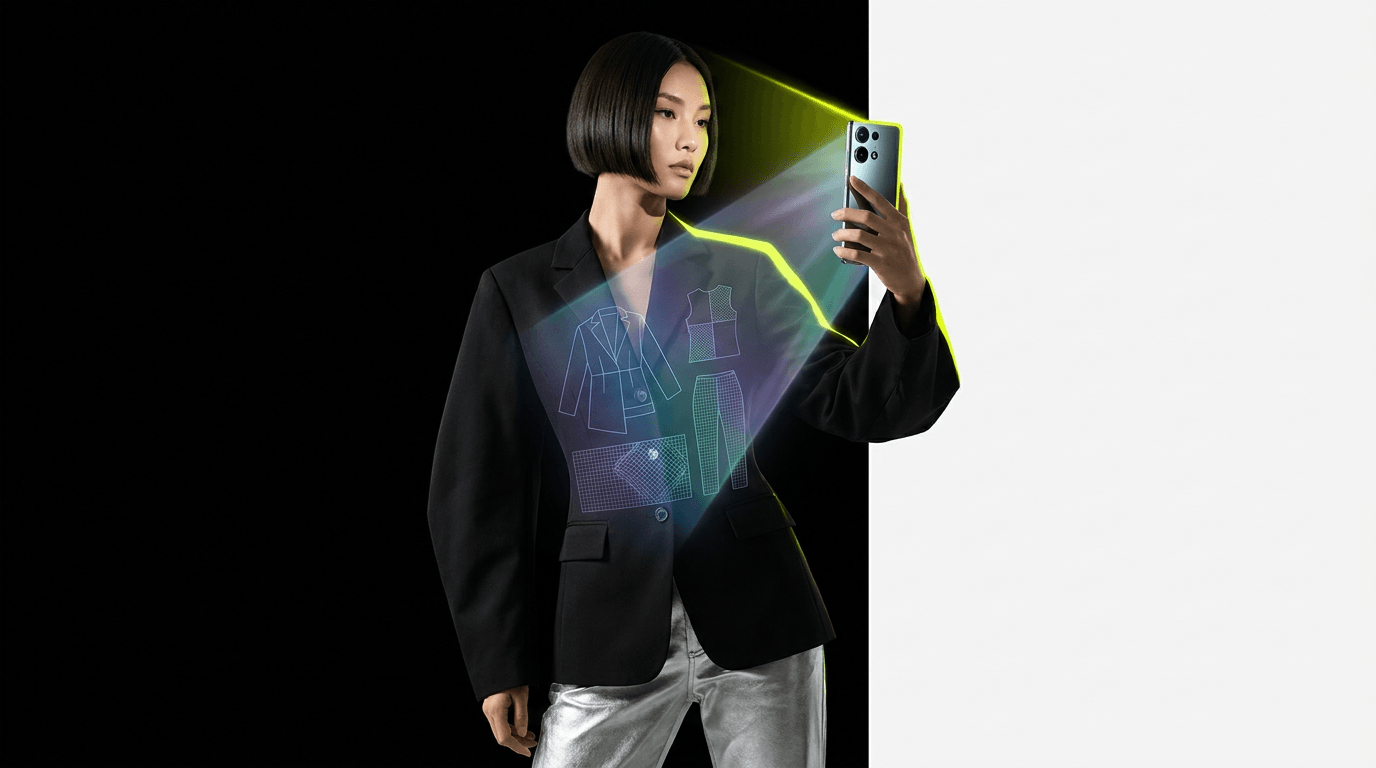
You've seen the demos: point your phone at your face, and a lipstick shade appears on your lips. Hold up your wrist, and a watch materializes on your skin. AR shopping has been hyped as the future of retail for years, and now it's actually showing up in mainstream apps, brand websites, and social media filters. But if you've ever tried to use it to decide whether a blazer actually fits your shoulders or if those pants suit your proportions, you probably hit a wall fast.
The truth about AR shopping is more nuanced than the marketing suggests. Some of it is genuinely useful. Some of it is still more demo than practical tool. And a newer generation of AI-powered virtual try-on is doing things that traditional AR never could. This guide cuts through the noise to explain what AR shopping actually is, where it works, where it falls short, and how tools like Alvin's Club are pushing the experience into genuinely useful territory.
What Is AR Shopping, Really?
Augmented reality (AR) shopping overlays digital product images onto a live or static view of the real world, typically through your phone's camera or a brand's app. Instead of imagining how something might look on you, AR tries to show you directly. The concept sounds straightforward, but the technology underneath varies enormously in quality and ambition depending on who built it and what category it's designed for.
In beauty, AR shopping has worked reasonably well for years. L'Oréal, Sephora, and MAC all let you "try on" lipstick, eyeshadow, and foundation shades using face-tracking technology. Because makeup sits on the surface of the face and color is the primary variable, the rendering is convincing enough to genuinely inform purchasing decisions. In furniture, IKEA's AR placement tool lets you drop a virtual sofa into your living room to check scale and color. Again, it works because the variables are manageable: a static object in a static space.
Clothing is where things get complicated. Garments drape, stretch, bunch, and behave differently depending on fabric weight, cut, and the three-dimensional shape of the body wearing them. Simulating that in real time with a phone camera is a fundamentally harder problem, and many early AR clothing try-on experiences reflected that difficulty by producing results that looked more like digital stickers than realistic fits.
How AR Shopping Actually Works
At a technical level, AR shopping relies on a combination of computer vision, 3D modeling, and real-time rendering. The app uses your camera to detect key reference points, whether that's your face, your body outline, or the physical space around you. It then maps a digital version of the product onto those reference points and renders it in a way that moves with you as you shift position.
For face-based try-on, this works through facial landmark detection, identifying points like the corners of your lips, the bridge of your nose, and your cheekbones. For body-based clothing try-on, the challenge escalates significantly. The system needs to estimate body proportions, account for depth and perspective, simulate fabric physics, and update all of this in real time as the person moves. That's why most live-camera clothing AR still looks noticeably artificial compared to the polished demos brands show in their promotional materials.
A growing alternative approach uses static photo-based try-on, where you upload a photo of yourself and the system composites a garment onto your image using AI-powered segmentation and rendering. This approach sacrifices the real-time magic but often delivers far more realistic and useful results because it can process the image more carefully without needing to run at camera frame rates.
The Different Types of AR Try-On in Fashion
Not all virtual try-on experiences are built the same way. It helps to understand the categories so you know what to expect from each:
- Live camera overlay: You see yourself in real time with the garment overlaid on your moving image. Fast and interactive, but often the least realistic for clothing due to the complexity of real-time fabric simulation.
- Photo-based virtual try-on: You upload a photo and the system renders the garment onto your still image using AI. Slower but significantly more realistic, especially for full-outfit visualization.
- 3D model exploration: Products are displayed on a standardized or customizable 3D body model that you can rotate and inspect. Useful for understanding construction and fit details, but less personalized to your actual body.
- Size recommendation tools: Not visual AR at all, but often grouped with try-on features. These use your measurements or purchase history to predict fit, which can actually be more practically useful than a visual overlay for sizing decisions.
Each type has its place, and the best shopping experiences often combine more than one approach. Understanding which type you're using helps you calibrate how much weight to give the result when making a purchase decision.
AR vs. AI-Powered Virtual Try-On: What's the Difference?
This distinction matters more than most people realize. Traditional AR in shopping is primarily a rendering problem: take a digital asset and composite it over a real-world image convincingly. AI-powered virtual try-on goes further by actually understanding what it's looking at, your body shape, the garment's structure, how fabric would realistically fall, and how lighting would interact with the material.
AI-driven systems can also do things that basic AR simply cannot. They can suggest that a particular cut might not work well for your proportions and offer alternatives. They can recognize a garment from a photo and find similar items at different price points. They can learn your preferences over time and surface looks you're statistically more likely to love. This is the category where genuinely useful fashion technology is happening right now, and it's where the gap between a novelty demo and a tool that actually changes how you shop starts to close.
The Benefits That Are Actually Real
When AR and AI-powered try-on work well, the benefits for shoppers are meaningful and measurable. Here's what the evidence and experience actually supports:
- Reduced return rates: Shoppers who virtually try on clothing before purchasing return items significantly less often. Alvin's Club's virtual fitting room technology is associated with a 25 to 48 percent reduction in return rates, which represents real money saved and environmental impact reduced.
- More confident purchasing decisions: Seeing a garment on your own body, even through a photo-based composite, gives you far more information than a flat product image on a generic model whose proportions may be nothing like yours.
- Discovery of styles you wouldn't otherwise try: Many shoppers self-censor when browsing, dismissing items they think won't work for them without trying. Virtual try-on lowers the barrier to exploration by making "trying" frictionless.
- Time savings: Narrowing down options virtually before ordering reduces the physical try-on burden and decision fatigue that makes online shopping exhausting.
The Honest Limitations You Should Know
Giving you an honest picture means acknowledging what AR shopping still can't do well. Fabric texture and drape remain imperfect in most rendering engines, so the weight and movement of a silk blouse versus a structured denim jacket often gets lost in translation. Color accuracy depends heavily on lighting conditions and screen calibration, meaning the rust-orange you see on screen may shift depending on your monitor or phone display.
Most AR try-on also struggles with layering, seeing how a tucked shirt interacts with high-waisted trousers, or how a longline coat falls over a chunky sweater. The more complex the outfit construction, the more the technology tends to simplify or approximate rather than accurately simulate. And while AI-powered systems are improving quickly, no virtual try-on can replicate the sensory information of physically wearing something: the way the waistband sits, whether the shoulders bind when you lift your arms, or how a fabric feels against your skin.
The smart approach is to treat AR try-on as a powerful filter and confidence tool, not as a perfect replacement for physical fitting. Use it to eliminate obvious misses and identify strong candidates, then apply your judgment for the final call.
How to Use AR Shopping Without Getting Burned
Getting genuine value out of AR and virtual try-on features comes down to using them strategically rather than treating them as magic. Here's a practical approach that actually works:
- Use a high-quality, well-lit photo of yourself. The output quality of any AI-powered try-on is directly proportional to the input quality. A clear, neutral-background photo in fitted clothing gives the system the best chance to accurately map garments onto your body shape.
- Focus on silhouette and proportion, not fine detail. Virtual try-on excels at showing you whether an oversized blazer overwhelms your frame or whether wide-leg trousers balance your proportions. Trust that information. Be more skeptical about fine texture rendering and exact color matching.
- Try styles outside your usual comfort zone. This is where the technology pays for itself. When trying something new costs you nothing but thirty seconds, you can afford to experiment. Many shoppers discover new silhouettes and colors this way that they'd never have ordered otherwise.
- Cross-reference with real reviews about fit. After narrowing your options with virtual try-on, read customer reviews that mention sizing and fit before purchasing. The combination of visual confirmation plus real-world feedback is a significantly stronger signal than either alone.
- Use dupe-finding tools after try-on. Once you've confirmed a style works on your body, use image recognition tools to surface budget-friendly alternatives before defaulting to the expensive original. This workflow, try first, then find the best price, is one of the most practical ways to use the current technology.
How Alvin's Club Takes This Further
Most AR shopping tools are built around a single product category or a single brand's inventory. Alvin's Club takes a different approach by functioning as a full AI-powered fashion shopping agent that combines virtual try-on with intelligent discovery, personalization, and budget-conscious alternatives.
The platform's Celebrity Try-On feature lets you upload your own photo to see how complete outfits from style icons like Zendaya, Dua Lipa, and Timothée Chalamet would look on your actual body, not on a model whose proportions may be completely different from yours. This solves one of the core frustrations of fashion inspiration: seeing a look you love and having no idea whether it would actually work for you. By seeing the silhouette, colors, and cut rendered on your own image, you get genuinely useful information rather than abstract inspiration.
After virtually trying on a look, Alvin's Club's Affordable Dupes finder uses image recognition to automatically surface budget-friendly alternatives to the high-end pieces in that outfit. If Zendaya's look features a Celine coat and Valentino heels, the platform finds comparable pieces at accessible price points without you having to manually search. This transforms the inspiration-to-purchase workflow from something frustrating and expensive into something genuinely achievable.
For everyday outfit decisions, the platform's Outfit Journal and wardrobe inspiration tools solve the "full closet, nothing to wear" problem by offering personalized OOTD suggestions calibrated to seasons, holidays, and your existing virtual wardrobe. Meanwhile, the Trend Feed aggregates global street style in real time so you can stay ahead of emerging movements without having to curate dozens of Instagram accounts manually.
For shoppers who want to browse specific retailers, the Brand Look feature lets you explore and virtually try on curated looks from fast-fashion brands like Zara, streamlining the discovery process so you're not scrolling through hundreds of individual product pages to assemble an outfit. The result is a shopping experience that feels less like navigating a warehouse and more like working with a personal stylist who actually knows your budget, your body, and your taste.
The Bottom Line on AR Shopping
AR shopping is neither the revolutionary game-changer its biggest advocates claim nor the useless gimmick its skeptics dismiss. The reality sits somewhere more interesting in the middle. For beauty and accessories, it's already a genuinely useful decision-making tool. For clothing, the photo-based AI-powered approach is meaningfully better than traditional live-camera AR, and it's improving quickly. The key is knowing what each tool does well and using it for that specific purpose rather than expecting it to replicate the full physical fitting experience.
The shoppers who are getting the most value from this technology right now are the ones using it as a confident first filter, combining visual try-on with community reviews, using it to explore styles they'd normally dismiss, and then layering in smart tools to find the right price once they know what actually works on their body. That workflow, try first, confirm with data, buy smarter, is where AR shopping stops being hype and starts being genuinely useful.
Ready to Try Before You Buy?
Stop guessing how clothes will look on your body. Alvin's Club combines AI-powered virtual try-on, celebrity outfit inspiration, smart dupe-finding, and real-time trend feeds into one fashion-forward platform built for real budgets.