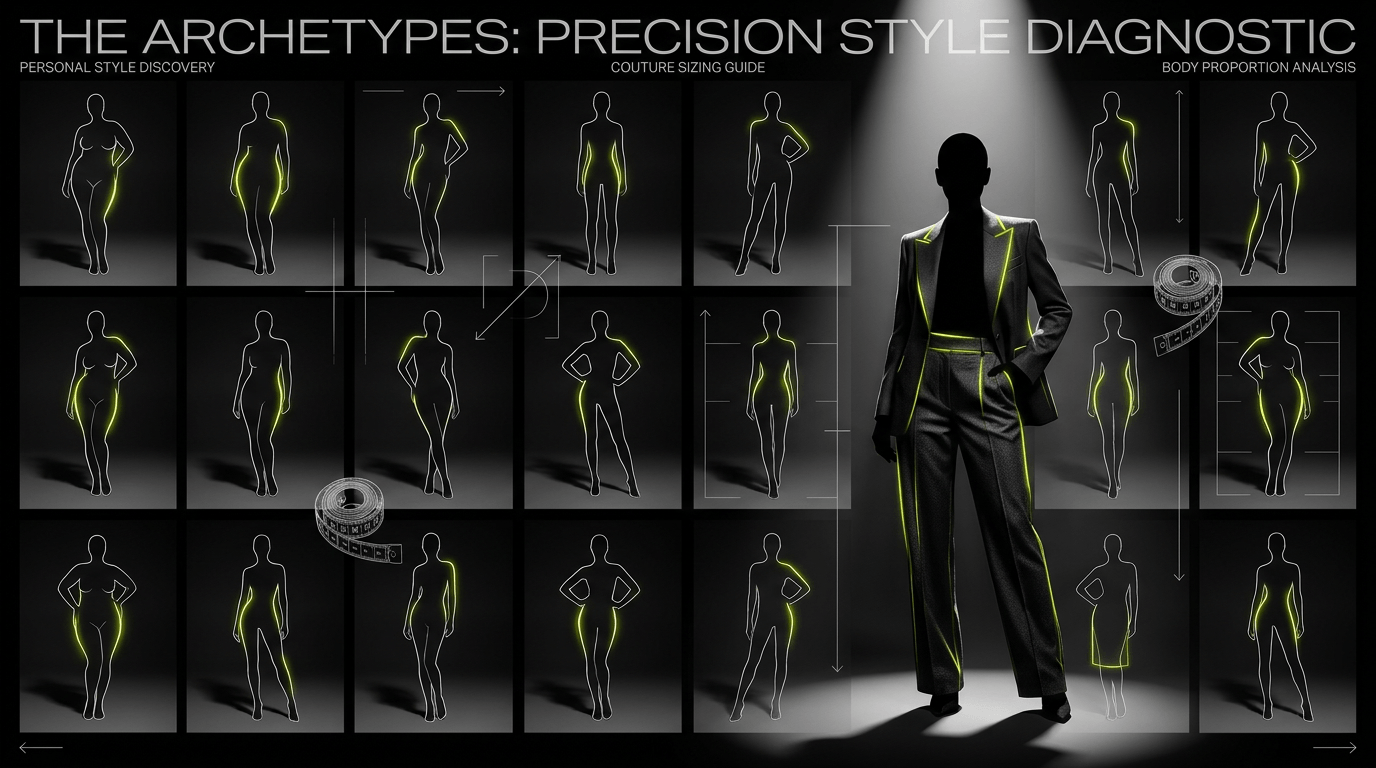
If you've ever stood in front of a packed wardrobe feeling like nothing fits right, chances are the problem isn't your body — it's that you haven't found your style language yet. That's exactly what the Kibbe body type quiz was designed to solve. Developed by image consultant David Kibbe in his 1987 book Metamorphosis, the Kibbe system goes far beyond the outdated apple-pear-hourglass geometry most of us grew up with. Instead, it categorizes people into one of 13 Image Identities based on the interplay of yin (soft, curved, delicate) and yang (sharp, angular, bold) energy in your facial features, bone structure, and body flesh — giving you a truly personalized blueprint for dressing.
In this guide, you'll walk through the complete Kibbe body type quiz step by step, learn what each of the 13 types actually means, and discover practical styling advice for every Image Identity. Whether you're a Dramatic Classic, a Soft Natural, or a Romantic, understanding your Kibbe type can transform the way you shop, get dressed, and ultimately feel in your clothes.
Kibbe Body Type Quiz
Discover your Image Identity — the yin-yang blueprint that transforms how you dress, shop, and feel in your clothes.
▸ 5 KEY TAKEAWAYS
+Yang
▸ THE YIN–YANG SPECTRUM
▸ 5 FAMILIES AT A GLANCE
▸ ALL 13 IMAGE IDENTITIES
▸ HOW TO TAKE THE QUIZ
▸ COMMON MISTAKES TO AVOID
Your Image Identity Is Waiting
Stop fighting your natural essence. When you dress in harmony with your Kibbe type, clothes stop feeling like a battle — and start feeling like an extension of who you actually are.
What Is the Kibbe Body Type System?
The Kibbe system is a holistic approach to personal style that treats the body as a complete artistic whole rather than a set of isolated measurements. David Kibbe argued that true style harmony comes from dressing in alignment with your natural essence — the unique combination of sharp and soft qualities that define how you look and move through the world. Unlike traditional body shape categories that focus purely on width at the shoulders, waist, and hips, Kibbe also evaluates the sharpness of your facial bones, the texture of your flesh, and the proportions of your limbs relative to your torso.
This is why two people with nearly identical measurements can belong to completely different Kibbe types. A tall woman with angular shoulders but a soft, fleshy face might be a Flamboyant Natural, while someone with similar dimensions but sharper facial architecture might be a Dramatic. The system is built on nuance, and that nuance is precisely what makes it so useful. When you dress in harmony with your Image Identity, clothes seem to melt onto your body rather than fighting against it — and that's a feeling no trend or price tag can manufacture.
The Five Kibbe Families Explained
Kibbe organizes his 13 types into five broad families, each representing a position on the yin-yang spectrum. Understanding these families first makes the full quiz far easier to navigate.
Dramatic (Pure Yang)
Dramatics sit at the extreme yang end of the spectrum. They tend to have sharp, angular bone structure, narrow vertical lines, and a bold, striking presence. There is very little softness or curve in the body or face. Clothing that works best here is sleek, geometric, and structured — think strong shoulders, long clean lines, and minimal embellishment.
Natural (Yang Dominant with Yin Blend)
Naturals have a strong yang framework but with a layer of softness — often seen as a slight bluntness rather than sharpness in their bones, and a more relaxed, broad physical presence. They look best in relaxed, unconstructed silhouettes with natural fabrics and an effortless, earthy aesthetic.
Classic (Balanced Yin and Yang)
Classics sit right in the middle of the spectrum with an even blend of yin and yang. Their features are symmetrical and moderate — nothing is extreme. Tailored, polished, and symmetrical clothing works beautifully, as any excess in either direction (too dramatic or too frilly) will feel off-balance.
Gamine (Combination of Extremes)
Gamines are a fascinating outlier: they mix sharp yang edges with petite yin delicacy. The result is a compact, pixie-like presence that feels simultaneously bold and small. Mixing and contrasting patterns, separates, and playful proportions are hallmarks of the Gamine aesthetic.
Romantic (Pure Yin)
At the opposite end of the spectrum from Dramatic, Romantics are defined by lush softness and pronounced curves throughout the body and face. Flowing, draped fabrics and rounded silhouettes that echo the body's natural curves are the Romantic's best friends.
The Kibbe Body Type Quiz: Step-by-Step
The original Kibbe quiz evaluates five categories: bone structure, body flesh, facial features, facial flesh, and a final section on overall height and proportions. Within each category, you select answers that range from strongly yang (A answers) to strongly yin (E answers), with blended options in between. Here's how to work through it:
- Assess Your Bone Structure. Stand in front of a mirror and look at your shoulders and hands. Are your shoulders sharp and angular (A), slightly wide and blunt (B-C), or narrow and sloped (D-E)? Are your hands and fingers long and angular, or short and tapered with fleshy palms?
- Assess Your Body Flesh. Look at your waist, hips, and bust. Is your body relatively straight with little curve (A-B), moderately defined (C), or does it have pronounced, lush curves (D-E)? Also consider whether your flesh feels taut or soft to the touch.
- Evaluate Your Facial Bones. Look at your jawline, cheekbones, and nose in photos or in the mirror. Are they sharp and chiseled (A), slightly defined (B-C), or rounded and soft (D-E)?
- Evaluate Your Facial Flesh. Notice the fullness of your lips, cheeks, and eyes. Sharp, sculpted facial flesh is yang; full, pillowy features with large luminous eyes lean yin.
- Note Your Overall Proportions. Are you tall with a long vertical line (yang), petite and compact (a mix), or moderate in height with balanced proportions (classic)? Kibbe emphasizes that height alone doesn't determine type — but it interacts with everything else.
Once you've worked through each section, tally whether your answers are mostly A-B (yang dominant), mostly D-E (yin dominant), mostly C (balanced), or a striking mix of A's and E's (Gamine). This pattern points you toward one of the five families, and from there you narrow down to your specific Image Identity.
All 13 Kibbe Image Identities at a Glance
Within the five families, Kibbe identifies 13 distinct types. Here's a quick-reference breakdown:
- Dramatic — Pure, extreme yang. Tall, angular, and striking.
- Soft Dramatic — Yang skeleton with prominent yin flesh and curves.
- Flamboyant Natural — Broad, blunt yang framework with a slightly loose, unconstructed quality.
- Natural — Moderate yang with a relaxed, earthy softness.
- Soft Natural — Yang bone structure softened significantly by yin flesh and gentle curves.
- Dramatic Classic — Balanced Classic base with a slight yang sharpness added.
- Classic — Perfect yin-yang balance. Symmetrical and moderate in all things.
- Soft Classic — Balanced Classic base with a slight yin softness and delicacy added.
- Flamboyant Gamine — Compact, petite frame with predominantly yang sharp features.
- Gamine — Equal mix of petite yin delicacy and sharp yang edges.
- Soft Gamine — Compact petite frame with predominantly yin soft, rounded features.
- Theatrical Romantic — Yin-dominant Romantic base with a slight yang sharpness in the bones.
- Romantic — Pure, extreme yin. Lush curves, soft flesh, and delicate features throughout.
How to Dress Your Kibbe Type
Knowing your Image Identity is only half the equation — understanding how to translate it into actual outfit choices is where the magic happens. Each type has a set of core principles that guide silhouette, fabric texture, pattern scale, and accessory choice.
Dramatics and Soft Dramatics
Dramatics thrive in sharp, geometric silhouettes with strong vertical lines. Think longline blazers, column skirts, structured coats, and minimal ornamentation. Soft Dramatics can add drama through bold prints and rich drape — a flowing silk maxi dress or an oversized structured coat plays perfectly to both the yang skeleton and yin softness. Both types benefit from avoiding anything too fussy, delicate, or petite-scaled.
Naturals
Naturals look best when they lean into easy, relaxed silhouettes that don't fight the body's natural breadth. Loose linen trousers, oversized knits, wrap dresses in natural fabrics, and layered pieces all shine here. Soft Naturals can add a little waist definition and slightly more delicate fabric choices than their Flamboyant counterparts, but both types should avoid overly stiff, tailored, or fussy constructions.
Classics
Classics need symmetry and balance above all else. Tailored blazers, A-line skirts, knee-length dresses, and symmetrical necklines are the bread and butter of this type. The key is to avoid anything too extreme — no overwhelming maximalism, no stark minimalism. Dramatic Classics can push slightly toward bolder accessories and sharper tailoring, while Soft Classics benefit from softer fabrications like jersey, chiffon, and cashmere.
Gamines
Gamines are made for mixing contrasts. Separates in different colors and textures, playful proportions, mixing prints, and bold accessories all work wonderfully here. The key principle is to keep things compact — cropped jackets, high-waisted trousers, and shorter hemlines honor the petite vertical line. Soft Gamines lean toward rounder, more delicate details, while Flamboyant Gamines can go sharper and bolder with their contrasts.
Romantics and Theatrical Romantics
Romantics are best served by clothing that flows with and around their curves — wrap dresses, soft ruffles, draped fabrics, delicate lace, and fitted silhouettes that follow the body's natural shape. Scale matters here: prints and accessories should be small and intricate to match the delicacy of Romantic features. Theatrical Romantics can introduce a touch more structure and bolder jewelry while keeping the overall sensibility soft and feminine.
Common Mistakes When Identifying Your Type
One of the most common pitfalls is conflating Kibbe typing with weight or body size. Kibbe himself has been clear that his system is not about measurements or a number on a scale — it's about the innate quality of your physical features. A larger person can absolutely be a Dramatic; a smaller person can be a Soft Dramatic. The quiz is evaluating architecture and essence, not dimensions.
Another frequent mistake is choosing an aspirational type rather than an accurate one. Many people are drawn to the Dramatic category because it sounds glamorous, or to Romantic because it sounds desirable — but forcing yourself into the wrong type will only recreate the same wardrobe frustrations you were trying to solve. Be honest with your answers, and if possible, ask someone who knows you well to give a second opinion on your bone structure and facial features. Photos also tend to reveal things that mirrors obscure.
Shop Smarter Once You Know Your Type
Knowing your Kibbe type gives you a powerful filter for every shopping decision — but applying that knowledge in real time while browsing online can still feel overwhelming. That's exactly where technology can close the gap. Once you know, for example, that you're a Soft Natural who needs relaxed, slightly draped silhouettes, you can use Alvin's Club's virtual try-on to see how specific celebrity outfits from icons like Dua Lipa or Zendaya actually look on your body before clicking buy — reducing guesswork and costly returns instantly.
If you've identified as a Dramatic Classic and want to find the perfect structured blazer without spending designer prices, Alvin's Club's affordable dupes feature automatically surfaces budget-friendly alternatives to high-end pieces after your virtual try-on, so you get the silhouette that works for your type without the Celine price tag. And when you're stuck in morning wardrobe paralysis despite knowing your type in theory, the personalized OOTD recommendations pull from your virtual closet to suggest daily outfits calibrated to the season, your style profile, and your existing wardrobe.
Understanding your Kibbe Image Identity is the starting point — but pairing that self-knowledge with smart tools that let you visualize, compare, and shop in alignment with your type is what turns fashion theory into a genuinely better wardrobe. The trend feed on Alvin's Club can also help you spot which emerging street style movements align with your Image Identity, so you're never chasing trends that work against your natural essence. You can also explore the Brand Look section to browse curated outfits from Zara and other fast-fashion brands — and try them on virtually to see exactly which silhouettes and pieces harmonize with your Kibbe type before you order.
Your Image Identity Is Waiting
The Kibbe body type system isn't a set of rules to follow — it's a framework for understanding yourself more deeply and dressing with genuine intention. When you stop fighting your natural essence and start dressing in harmony with it, getting dressed stops feeling like a chore and starts feeling like an extension of who you actually are. Whether you've just discovered you're a Theatrical Romantic or you've long suspected you were a Flamboyant Natural, the path forward is the same: use your Image Identity as a lens, not a cage, and let it guide you toward the silhouettes, fabrics, and proportions that make your body look and feel its absolute best. The most stylish version of you isn't a trend — it's already there, waiting to be dressed properly.
Ready to Dress Your Kibbe Type With Confidence?
Now that you know your Image Identity, see exactly how celebrity looks and brand outfits look on your body before you buy. Alvin's Club makes it effortless — try on, compare, and shop smarter, all in one place.
Explore Alvin's Club Download the App